
• (727) 586-2681
  • 1472 Jordan Hills Court, Clearwater, FL 33756

denture

Options for tooth replacement after tooth loss at Britten Periodontics in Clearwater, FL, including dental implants, bridges, and dentures to restore function and appearance.

Careful management of extraction sockets after a tooth is removed prevents unsightly bone loss and provides a better cosmetic outcome for tooth replacement. To increase the possibility of future implant placement, and to prevent more bone resorption, a ridge preservation procedure may be recommended. Without the use of a bone graft and collagen barrier at the time of extraction, studies show that 30-40% of the jaw bone is immediately lost. This is because your body perceives that once the root is removed, the bone is no longer needed and your body absorbs or removes it, creating a ridge deformity.

These ridge deformities leave you with inadequate bone and tissue thickness for either bridge or dental implant restoration. The defects may have been caused by trauma, developmental defects, periodontal disease, the wearing of dentures, or through previous tooth loss.
Ridge augmentation procedures have been shown to greatly enhance the cleansability and appearance of your restorations. They increase your chance for long term successful dental restoration, both esthetically and functionally. Ridge augmentation procedures may be performed with gum tissue and/or bone grafting materials.

For more info on our surgical procedures, visit:

Surgical Procedures

or contact us!

[iphorm id=”3″ name=”Contact form”]
Britten Perio

It is unfortunate when someone loses a tooth, but there are usually several options to replace it.

  1. Removable Partial Denture
  • Worn during the day, can replace one or many missing. We recommend taking them out at night and soaking them in a cleaning solution.  teeth.  Sometimes a partial denture may need metal clasps to help it stay in the mouth.
  • Unfortunately, these metal clasps may be visible when speaking or smiling.
  • They can move a little when speaking or eating, which can be uncomfortable.
  • No need to file down any teeth.
  • This option is often the most economical.

2.  Temporary Partial Denture

  • A short term solution for a missing tooth.
  • We call it a “flipper” because it flips in and out easily.
  • This is used when the tooth will be restored in the future with a bridge or an implant, but is worn during the healing phase.
  • Much like a removable partial denture, but usually less sturdy, less bulky, and less expensive.
  • No alteration to adjacent teeth

3. Bridge

  • A bridge is a fixed solution that stays cemented in the mouth and does not come out.
  • This method involves cutting down the teeth on either side of the missing tooth to be able to connect them together.
  • We recommend floss threaders, which slide under the bridge, to keep it clean.
  • The disadvantages for bridges are cutting down teeth that might be perfectly healthy, and sometimes bridges in the lower jaw do not last as long since the jaw flexes and the unbendable bridge can spring a leak on one side or the other that allows for decay or bacteria to seep in.
  • A bridge can replace one or two missing teeth easily, and sometimes more if there is enough support.

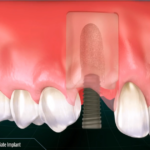
4. Dental Implant

  • A great way to replace a missing tooth.
  • This solution feels and acts the most like a natural tooth when chewing, brushing or smiling.
  • The implant replaces the actual root of the missing tooth and heals in the bone for several months.
  • We then place an abutment, to which a crown will be cemented.
  • A major advantage is no need to alter any other teeth when placing an implant.
  • An implant is a great solution for a single missing tooth, and even more implants can replace many missing teeth.
  • When smiling or talking there is no way to tell the difference between an implant and a natural tooth

5. Do Nothing. There is always the option to do nothing.

  • When a tooth is removed, the bone melts away and the other teeth in the area will shift to fill the gap.
  • This can sometimes create a difficult place to clean and lead to other problems like bone loss or decay around the existing teeth.
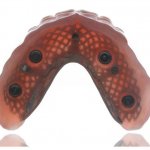
Hybrid dentures offered by Britten Periodontics in Clearwater, Florida, providing stable and natural-looking tooth replacement supported by dental implants.

If you’re tired of high maintenance and uncomfortable dentures, you might be able to have implants placed to support your denture. An implant-supported denture is used when a person doesn’t have any teeth in the jaw, but has enough bone to support implants. An implant supported denture snaps into place on dental implants. This prevents the denture from slipping or coming loose in the mouth. It also removes the need for denture paste or adhesives. The implant supported denture can be removed at night for cleaning or, if you have a fixed implant supported denture placed, your dentures will act as permanent teeth.

There are two types of implant supported dentures, bar-retained dentures and ball-retained dentures. Both types of dentures require two or more dental implants to be placed and both will provide you with a beautiful, natural smile.

Bar-Retained Dentures

In the bar-retained type of denture, three or more implants are surgically placed in the gums. Attached to these implants is a metal bar that runs along the gum line. The denture then rests on the metal bar and is attached using clips or other types of attachments. This type of implant-supported denture holds the denture in place without the steel studs used in ball-retained dentures.

Ball-Retained Dentures

Ball-retained dentures, also called stud-attachment dentures, use a ball-and-socket design to attach the dentures to the implants surgically placed in the gums. Traditionally, the denture is fitted with sockets and the implants have a ball on top of them. The denture and implants snap together where the ball and sockets meet.

Many patients prefer implant-supported dentures to traditional dentures because they alleviates much of the discomfort and rubbing of traditional dentures. The denture is held in place far more securely and is less likely to come loose. Dr. Britten is a dental implant specialist who can evaluate to see if you are a candidate for implant-supported dentures. Call us today 727-586-2681 or visit www.brittenperio.com

Back to Blog

appointment

Categories