• (727) 586-2681
  • 1472 Jordan Hills Court, Clearwater, FL 33756

periodontal disease

Smiling woman visiting Britten Periodontics in Clearwater, Florida

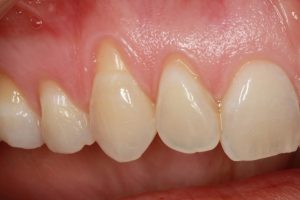
Gum recession refers to the loss of gum tissue along the gumline. This can occur as a result of periodontal disease (gingivitis, periodontitis, advanced periodontitis), the natural aging process, or abrasive habits when it comes to brushing the teeth.

Why should gum recession be taken seriously?

When gum recession occurs, the root structure of the tooth becomes exposed. This means that tooth decay and other problems can affect the teeth along the gumline and beneath it. Since healthy gums are essential for a healthy mouth, getting gum recession treated is important for lasting dental wellness. When recession occurs to the point that no firm gum tissue remains, this leaves the roots of the teeth and the underlying bone relatively unprotected, which could result in root sensitivity, bacterial penetration, decay and even loss of teeth.

A gingival graft is designed to address these problems. A thin piece of tissue is taken from the roof of the mouth or gently moved over from adjacent areas to provide a stable band of attached gum tissue around the tooth. The gingival graft may be placed in such a way as to cover the exposed portion of the root, however, the main objective is to re­establish the protective barrier or layer of the gum around the tooth. Occasionally, the patient may need multiple procedures to achieve the ideal amount of root coverage.

Dr. Britten has trained in the latest minimally invasive techniques of gum grafting and can often perform the entire procedure through a pinhole incision.

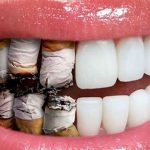
Harmful effects of smoking on teeth shown in patient image at Britten Periodontics in Clearwater, FL

Dr. Britten is highly concerned about his patients who smoke. The likelihood of developing advanced periodontal disease or gum disease can be up to six times higher in smokers. Periodontal disease is an extremely serious condition affecting not only the gums, but also the membranes and ligaments and bone supporting the teeth.

Many studies on smoking and periodontal disease have concluded that smokers have:

  • Deeper probing depths and a larger number of deep pockets in the gums.
  • More attachment loss including more gingival recession
  • More alveolar boneloss & tooth loss
  • Less gingivitis and less bleeding on probing
  • One of the major problems with smoking is that it tends to mask the damage being caused to teeth and gums. This damage can be difficult to detect, producing very few early warning signs of advanced periodontal disease.
  • For years it was thought that nicotine being a vasoconstrictor was causing less blood flow to the gums, causing less infection-fighting white blood cells to reach the area. Newer studies are showing that smoking appears to have a long-term effect on the inflammatory lesions, or diseased gums of smokers, which have less blood vessels in them than in non-smokers.
  • More teeth with furcation involvement (where the bone levels have been destroyed below the area where the roots of the teeth meet, leaving this area exposed, making it prone to further destruction as well as decay.
  • Additionally, nicotine affects saliva, causing it to become thicker so it is less able to wash away acid created after eating. As a result, heavy smokers can be more likely to suffer from tooth decay than non-smokers, even though they may practice good oral hygiene.
  • Smoking has a profound effect on the immune and inflammatory system. Smokers have more infection-fighting cells in their body, but fewer of these helpful cells make it into the gingival pocket. Studies also show that these good cells have a decreased ability to accomplish their function, which is to destroy harmful periodontal bacteria.
  • Adhesion molecules are found within smoker’s tissues, in the white blood cells, in the inflammatory lesions, and even in the supporting gingival tissues. Studies have shown impairment in defensive functions of other defensive blood cells, even those using smokeless tobacco due to the high concentrations of nicotine.
  • Smoking also impairs the healing of dental implants and even in the healing from all other aspects of periodontal treatment including non-surgical treatments (including scaling and root planing or “deep cleaning”), surgical treatment, bone grafting and tissue grafting.
  • Studies have shown that tobacco smoke and nicotine affect blood vessels in the gums, healthy bone-building cells, connective tissue matrix, the jaw bone and even the root surface itself. Tooth root surfaces in smokers have actually been shown to be contaminated by products of smoking such as nicotine, cotinine, acrolein and acetaldehyde, which may inhibit the gum tissue from healing around the roots of teeth as they should.
  • Smoking has been shown to affect human bone, and is a risk factor for osteoporosis, which is also a risk factor for periodontal disease.

As a periodontist, Dr. Britten is a specialist in treating advanced periodontal disease and is able to provide patients with the very latest techniques and treatments to help slow down this condition. Where teeth are lost then one option is to replace them with dental implants, but smoking is not advisable during this treatment because it does slow down healing.

If you do currently smoke and value your smile, it’s worth thinking about quitting.

Gum disease treatment at Britten Periodontics in Clearwater Florida

From Perio.org

“Nearly one out of every two American adults aged 30 and over has gum disease, also known as periodontal disease. Periodontal disease is a chronic inflammatory disease that affects the gum tissue and bone supporting the teeth. The early stages of periodontal disease are often asymptomatic; many adults may have the disease and not know it.

“Periodontal disease is insidious,” warns Nancy L. Newhouse, DDS, MS, President of the American Academy of Periodontology (AAP) and a practicing periodontist in Independence, Missouri. “Many people don’t even know they have a problem until it turns into a severe case. Just because your teeth and gums don’t hurt, doesn’t mean your mouth is healthy.”

Over time, inflammation as a result of periodontal disease causes the gums and bones surrounding the teeth to recede….

Symptoms of periodontal disease include:
• Bleeding gums during brushing
• Red, swollen or tender gums
• Gums that have pulled away from the teeth
• Persistent bad breath
• Pus between the teeth and gums
• Loose or separating teeth
• A change in the way your teeth fit together when you bite:

Combat periodontal disease with routine brushing and flossing, regular dental hygiene visits (frequency recommended by your dental professional) and a yearly comprehensive periodontal examination.

#brittenperio #clearwaterperiodontist

Educational graphic on periodontal disease treatment by Britten Periodontics in Clearwater, Florida
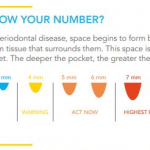
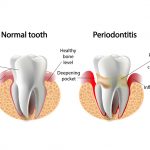
When you have periodontal disease, space begins to form between your teeth and the gum tissue that surrounds them. This space is called a periodontal pocket. The deeper the pocket, the greater the risk of tooth loss.
 
Your dentist or dental hygienist will perform a full periodontal charting at your visit to check for pocketing, infection (bleeding or pus), gum recession, & bone loss or defects in the bone. #brittenperio #clearwaterperiodontist
Educational graphic on periodontal disease treatment by Britten Periodontics in Clearwater, Florida

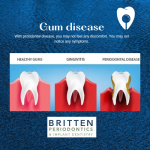
A silent disease.

With periodontal disease, you may not feel any discomfort. You may not notice any symptoms. But treating periodontal disease quickly is of the utmost importance.
 
With proper diagnosis and professional instruction from a dentist, you can protect your pearly whites for years to come.
 
Do you think you’re suffering from periodontal disease? Or has it been years since your last checkup?
Then please schedule an appointment with your dentist or periodontist ASAP! #brittenperio #clearwaterperiodontist
Educational graphic on periodontal disease treatment by Britten Periodontics in Clearwater, Florida
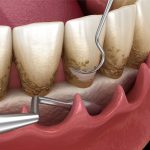
Bacteria in our mouths are constantly creating plaque. If bacterial plaque on the teeth isn’t removed, the gums can become infected and inflamed.
 
– Plaque builds up and gum tissue becomes infected. Redness, tenderness, swelling and bleeding may occur, but are not always present.
 
-Pockets deepen between teeth and gums. Gums pull away from the teeth while bacteria begin to damage supporting structures.
 
-Infection spreads around teeth. Bones, gums, and connective tissue can be permanently damaged, and teeth may need to be removed.
If you think that you may be suffering from early, moderate or severe periodontal disease, contact your dental professional ASAP!
Educational graphic on periodontal disease treatment by Britten Periodontics in Clearwater, Florida

The best way to prevent periodontal disease is to take good care of your teeth and gums at home. This includes brushing your teeth after every meal and before bedtime, flossing at least once each day, and seeing your dentist or periodontist for regular exams twice a year. Spending a few minutes a day on preventative measures may save you the time and money of treating periodontal disease!

-Perio.org

Educational graphic on periodontal disease treatment by Britten Periodontics in Clearwater, Florida

A team of international researchers published their findings in the Journal of Clinical Periodontology this month stating that patients with Gum Disease are more likely to have severe complications from COVID-19. 568 patients were studied and those with periodontitis – the most severe form of gum disease – were more likely to experience COVID‐19 complications. These complications included including death, ICU admission, and the need for assisted ventilation.

Dr. Todd Britten, a periodontist in Clearwater, Florida says that this study reinforces what he tells his patients every day – Oral health is extremely important for overall health. “This study, showing that patients with gum disease are at least three times more likely to have severe complications from the COVID-19 virus, shows us that treating and controlling periodontal disease remains extremely important, even in a pandemic.”

Dr. Britten stressed this study shows patients should still continue to see their periodontist or dentist. “Depending on your needs, your dentist or periodontist can treat gum disease infection through surgical or non-surgical therapy.” Dr. Todd Britten also said it is crucial that patients also keep dental hygiene cleaning visits to prevent gum disease and for those who have been treated for gum disease in the past stay on a 3 or 4 month schedule with their dental hygienist to avoid periodontal reinfection.

The findings also show the importance of good oral hygiene care at home during the COVID-19 pandemic, says Dr. Britten. According to the Academy of Periodontics, the nation’s leading organization of periodontists, “systemic inflammation is not only linked with periodontal disease, but to several other respiratory diseases as well.” Dr. James G. Wilson, President of the AAP states that this study linking periodontitis and COVID-19 complications, “Therefore, maintaining healthy teeth and gums in an effort to avoid developing or worsening periodontal disease is absolutely crucial in the midst of a global pandemic like COVID-19, which is also known to trigger an inflammatory response.” Dr. Britten states he emphatically agrees with the AAP.

Oral hygiene instructions provided by Britten Periodontics in Clearwater, Florida

Periodontal disease is rarely found in children, and only sometimes found in adolescents. However, children should still learn the importance of keeping their teeth and gums healthy to prevent periodontal disease in the future. Children should brush their teeth twice a day and learn how to floss properly- if children learn how to floss at an early age, they will be more likely to make it a lifetime habit. These two simple acts will help protect their teeth and gums from periodontal disease.

As a parent, you should also be aware of the warning signs of periodontal disease, which include red, swollen, bleeding gums or bad breath that won’t go away. If your child develops any of these symptoms, tell your dental professional right away. It’s also a good idea to ensure your dental professional knows your complete family history, as genetics can play an important role in the early development of periodontal disease.

Perio.org

Smiling couple visiting Britten Periodontics in Clearwater, Florida

Research has shown that periodontal disease is caused by the inflammatory reaction to bacteria under the gums, so periodontal disease technically may not be contagious. However, the bacteria that cause the inflammatory reaction can be spread through saliva. This means that if one of your family members has periodontal disease, it’s a good idea to avoid contact with their saliva by not sharing eating utensils or oral health equipment. If you notice that your spouse or a family member has the warning signs of a possible periodontal problem (bleeding, red and swollen gums, or bad breath) you may want to suggest that they see the periodontist for an exam. It may help to protect the oral health of everyone in the family.

Perio.org

Back to Blog

appointment

Categories